The Fan You Didn't See Coming: Why Your Accidental Audience Is the One That Matters
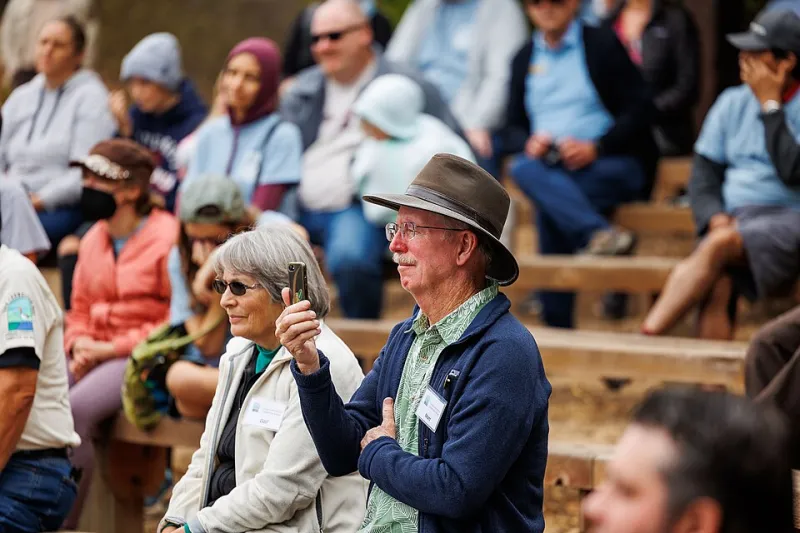
Photo: USFWS Pacific Southwest Region, Public domain, via Wikimedia Commons
There's a version of the artist's story that goes like this: you make your work, you define your audience, you target that audience, and eventually they find you. Clean. Linear. Satisfying.
Except that's not really how it works. Not for most of us.
What actually happens — if you're lucky and you're paying attention — is that someone completely outside your mental blueprint stumbles into your world and becomes your most passionate advocate. A 58-year-old retired teacher at your alt-folk show in a basement venue in Columbus. A teenage skateboarder who found your jazz-influenced EP through a cooking video on TikTok. A middle-aged guy in rural Tennessee who somehow ended up on your experimental dance theater livestream and cried through the whole thing.
Those people weren't in your deck. They weren't in your marketing plan. And if you'd been too busy curating for your "ideal" fan, you might have missed them entirely.
The Psychology of the Imaginary Fan
Here's where it gets interesting. When we construct an ideal audience in our heads, we're not just doing marketing — we're doing something more personal and a lot more complicated. We're deciding who deserves our work. Who gets to be in the room.
That's a form of gatekeeping, even when it comes from a place of creative integrity.
Artists do it for understandable reasons. You want your work to land with people who "get it." You're protective of what you've made. You've watched other creators dilute themselves chasing numbers and you swore you'd never do that. All fair. But there's a quiet arrogance built into the assumption that you already know, before the work goes out into the world, exactly who it's going to resonate with.
The truth? You don't. And neither does anyone else.
Genre-Crossing Is the Rule, Not the Exception
Look at almost any artist with a genuinely devoted following and you'll find a fanbase that defies the original target. Brandi Carlile spent years being shelved in the Americana section while quietly building a fanbase that spans country diehards, indie rock kids, and LGBTQ+ communities who found something in her music that felt like home. She didn't engineer that cross-pollination. It happened because her work was honest enough to travel.
Or think about how a Broadway cast recording ends up in the workout playlists of people who've never seen a musical in their lives. How a spoken word performance artist in Brooklyn finds a following in rural Georgia because someone shared a clip. How a contemporary dancer's YouTube channel gets picked up by the chronic pain community because her movement vocabulary gave language to something they couldn't articulate.
Art doesn't stay where you put it. It migrates. And the communities it lands in are often the ones that needed it most.
The Accidental Audience Is Often the Sustainable One
There's a practical argument here, too, beyond the philosophical one.
When you chase a narrow, pre-defined audience, you're essentially trying to compete within an already crowded lane. You're measuring yourself against everyone else making work for that same slice of the market. You're optimizing for people who have a hundred other options that look a lot like yours.
But the person who finds you sideways? They weren't looking for you. They don't have a reference point. You're not competing with anyone in their mental landscape because you arrived somewhere unexpected. That novelty creates stickiness. It creates the kind of fan who tells other people, because they feel like they discovered something.
That word-of-mouth energy — organic, unforced, driven by genuine surprise — is what actually builds careers over time. It's harder to manufacture than a targeted ad and infinitely more durable.
What Artist Gatekeeping Actually Costs You
I've talked to performers who quietly discourage certain crowds. Who feel vaguely uncomfortable when their work gets picked up by a demographic they didn't intend. Who've said things like "that's not really my audience" as if that settles something.
What it actually settles is a ceiling.
When you decide in advance who your work is for, you're also deciding who it's not for. And that's a creative tax you pay every single time someone walks through the door you left cracked open and finds something real inside. Turning that into a problem is a choice. Welcoming it is also a choice.
The artists I've watched build something lasting — not just a moment, but a career — tend to have a quality of openness about who shows up. Not indifference. Not shapelessness. But a genuine curiosity about what their work unlocks in people they never anticipated.
How to Actually Let Your Audience Find You
This isn't an argument for making work that appeals to everyone. That's a different trap entirely. The goal isn't to be all things to all people — it's to be fully yourself and then get out of the way.
A few things that help:
Stop writing audience personas into your creative process. Personas are useful for marketing logistics. They're poison in the studio. Make the work first. Figure out who it's for after it exists.
Pay attention to who actually shows up. Not who you hoped would show up. Who's in the room, in the comments, in the emails? What are they saying? That data is more valuable than any demographic projection.
Resist the urge to explain who your work is for. The more you bracket your audience in your own bios and press materials, the more you're pre-screening people out. Let the work do the talking.
Follow the unexpected connection. When someone from an unlikely corner finds your work meaningful, get curious about that. Ask questions. Show up in spaces you wouldn't have targeted. See what happens.
The Room You Didn't Plan For
The most moving moments I've experienced as a performer weren't the ones where I looked out and saw exactly the audience I'd imagined. They were the moments where I saw someone I didn't expect — someone who had no business being there by any conventional logic — and watched something land.
That's not a failure of targeting. That's the whole point.
Your accidental audience isn't a consolation prize. They're the proof that your work has range you haven't fully mapped yet. And if you're willing to follow them instead of redirecting them, they might just take you somewhere your ideal fan never would have.