Nobody Planned This: The Unexpected Partnerships That Changed Everything
Photo: two musicians collaborating spontaneously in a studio or backstage setting, via img.freepik.com
I had a whole plan. Carefully curated collaborators, a shared aesthetic vision, a mood board that took me two weekends to build. And then the person I'd spent three months coordinating with had to cancel four days before the show.
What happened next? Something better than anything I'd planned.
That's the thing about creative partnerships nobody really talks about — the ones that stick with you, the ones that push your work into territory you didn't know you were capable of, almost never come with a pitch deck attached.
The Psychology Behind the Happy Accident
There's actual science behind why unplanned collaborations can hit differently. Psychologists who study creativity talk a lot about something called "incidental exposure" — the idea that when you're not actively searching for something, your brain is in a more relaxed, associative state. You're not filtering. You're not auditing every new idea against a checklist of what your brand is supposed to be.
When you meet a creative collaborator by accident — at a friend's birthday party, backstage at someone else's show, in line at a coffee shop in Nashville — neither of you is performing a pitch. You're just two people talking. And that conversation, free from the weight of expectation, tends to go somewhere real.
I've started thinking of these moments less like accidents and more like invitations I didn't RSVP to.
The Substitution That Rewrote My Whole Sound
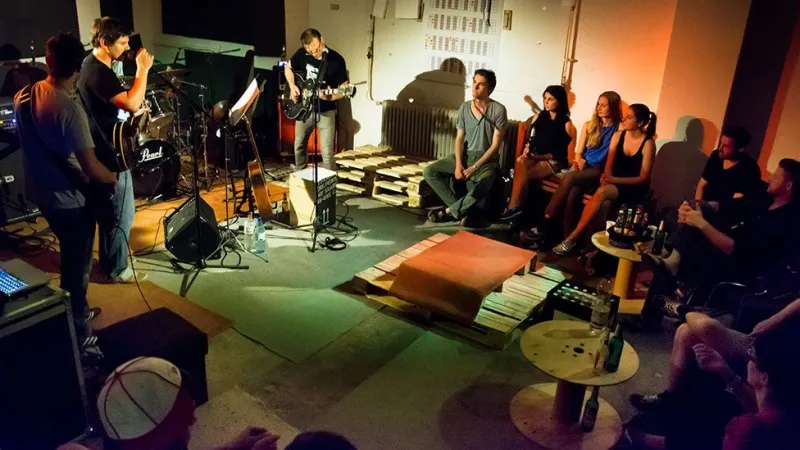
A few years back, I was doing a small run of acoustic performances along the East Coast. My usual guitarist had a family emergency — completely understandable, no hard feelings — and I had about 36 hours to find someone who could learn my set. A mutual friend suggested a guy named Devin who played out of Philly. I'd never heard of him.
Devin showed up with a totally different sensibility than what I was used to. Where my regular collaborator played clean and restrained, Devin was loose, improvisational, almost conversational with the instrument. It made me nervous at first. I like knowing what's coming.
But in that first show, something cracked open. Because I couldn't rely on muscle memory — because Devin was unpredictable in the best possible way — I had to actually listen. I had to respond in real time. The performance stopped being a rehearsed thing and started being a living thing.
I ended up working with Devin for the better part of a year. Some of the best material I've ever made came out of that stretch.
None of it was planned.
Why We Resist the Unplanned
Here's the honest part: I am a planner. I love a spreadsheet. I love knowing what's coming and having a backup for the backup. And I think a lot of artists are the same way, especially now, when so much of the creative industry runs on strategy and branding and intentional storytelling about who you are and who you work with.
There's pressure — real, constant pressure — to make every collaboration look deliberate. To have a reason for every pairing that makes sense on paper, that fits the narrative, that reads well in an announcement post. And that instinct isn't wrong, exactly. But it can wall you off from the kind of work that surprises even you.
When everything is curated, nothing is discovered.
"Wrong Place, Right Time" Moments Are Worth Paying Attention To
I've started cataloging what I think of as my "wrong place, right time" moments — not because I'm precious about them, but because I want to remember how they felt so I can stay open to more of them.
One of the most significant happened at an open mic I almost didn't go to. I was tired. I had an early morning the next day. I went anyway because a friend guilted me into it. At the back of the room, I ended up sitting next to a visual artist who was there for the same reluctant reason. We started talking during a particularly long set change. By the end of the night, we were sketching out an idea for a multimedia piece that I'm still proud of today.
The thing about these moments is that they don't announce themselves. You don't get a notification that says hey, pay attention right now, something important is about to happen. You just have to be present enough to notice.
How to Stay Open Without Losing Your Footing
I'm not saying throw out the mood board. I'm not saying stop being intentional about who you work with or what you create. But there are a few things I've genuinely tried to practice that have made me more available to the unplanned:
Say yes to the room before you say yes to the project. When someone interesting walks into your creative orbit, engage with them as a person first. Don't immediately assess whether they fit your current vision. Just talk. The project question can come later.
Let the first session be weird. When you do end up in an unexpected collaboration, resist the urge to immediately impose structure. Give the weirdness some space. Some of the best ideas I've had started as something that felt completely wrong.
Stop treating your brand like a cage. Your aesthetic identity should be a living thing, not a wall. The collaborators who challenge your sound, your look, your approach — they're not threats to your vision. They're the ones who help it evolve.
The Rain Doesn't Ask Permission
I've thought a lot about what it means to work in this industry with a name like mine. Rain doesn't schedule itself. It doesn't ask if it's a good time. It just shows up, changes the atmosphere, and makes everything smell different afterward.
The best creative partnerships I've had work the same way. They arrived uninvited. They changed the conditions I was working in. And the work that came out of them carries a texture that nothing carefully orchestrated has ever quite matched.
So yeah — keep your spreadsheet. Keep your strategy. But leave the door open a crack. The most interesting collaborator you'll ever have might be standing just outside it, waiting to ask if you need a last-minute guitarist.